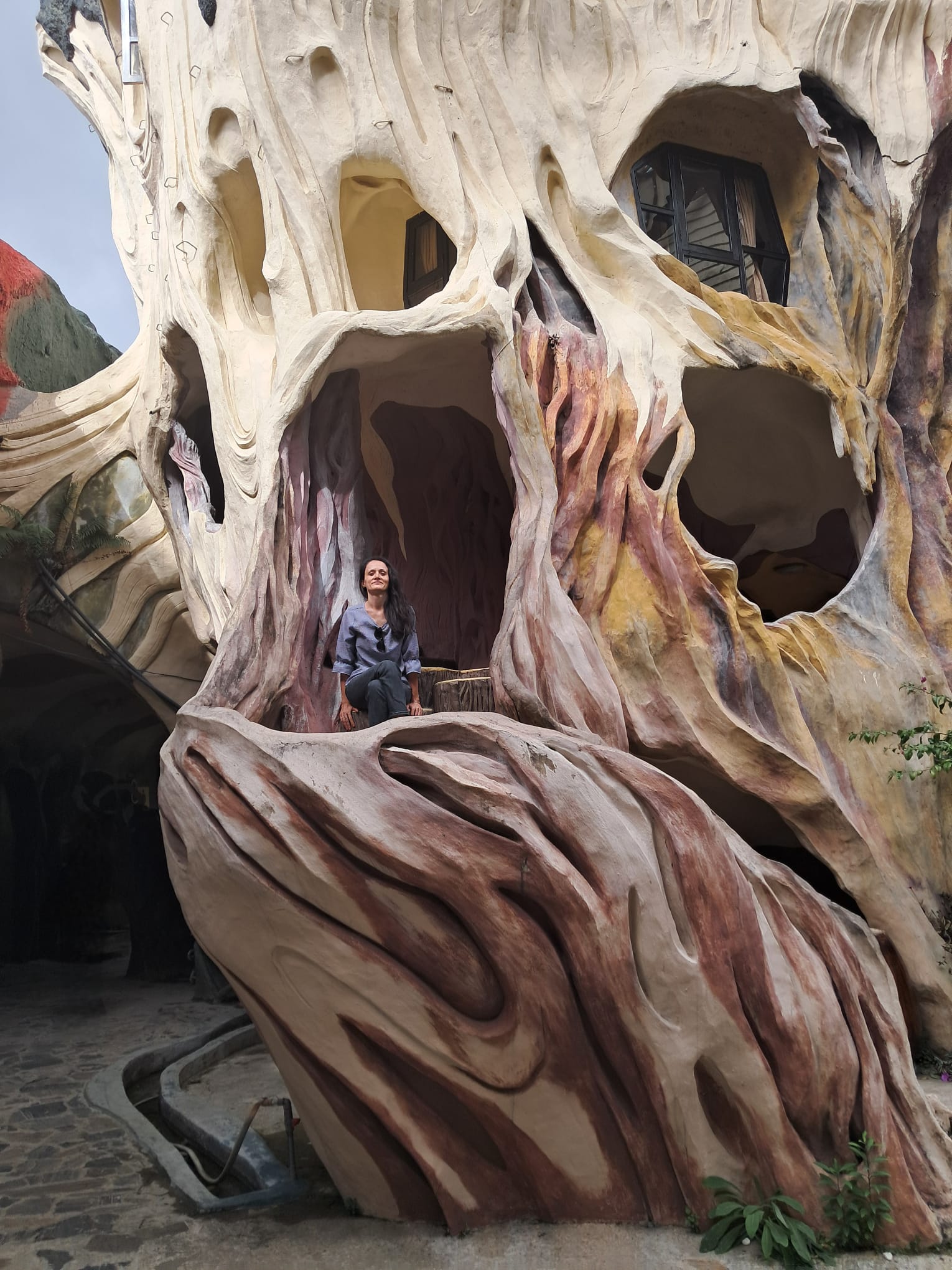
I am Romanian. I studied in Germany and France. I came to Spain as a foreign press correspondent, and I stayed. I wrote a doctoral thesis on how cultural identity is reflected in the Romanian ethnic press in Spain — how a community that finds itself elsewhere constructs and projects its own image, negotiates its sense of belonging through the words it chooses to publish about itself. And when I read Kapuściński’s Travels with Herodotus for the first time, I genuinely felt I was reading something of my own experience.
I re-read it recently as part of a BoJo Club — a book club within a journalism community — organized online in Klagenfurt. The format itself already says something. A BoJo Club is a deliberate slowing down: you read carefully, you share impressions, and you listen to how the same pages land differently depending on who is sitting across the table from you. In a media landscape already cemented on speed and fragmentation, it turns out to be the right way to approach a book that is itself about the value of taking your time with the unfamiliar.
Kapuściński: the journalist as historian of present times
Of course, nothing in my experience is the same as Kapuściński’s, not even the circumstances. Ryszard Kapuściński leaves communist Poland in the late 1950s for his first foreign assignment, clutching a copy of Herodotus’s Histories that his editor has pressed into his hands almost as an afterthought. What follows is not simply a travel memoir but a sustained meditation on the meaning of crossing a border — geographically, culturally, and personally. He is a man from a country sealed off from the world, suddenly thrown into India, then China, then Africa, armed with an assignment and a book written two and a half thousand years before.
Kapuściński has not been without his critics. In his work, the lines between witnessed fact and literary reconstruction have often been noticed to be deliberately blurred. Paradoxically, he himself, however, was clear on how he understood his role: a documentarian, a historian of present times. I re-read him with that awareness. What I take from him is not a methodology to replicate but a posture to consider: the value of genuine attention, of entering a foreign reality without the armour of premature conclusions.
Intellectual curiosity as intercultural skill
That posture has a name, I think, and it is simply curiosity. I never felt the tourist’s curiosity, satisfied by surfaces, nor, despite my academic research, the scientist’s careful distance, which keeps experience at arm’s length for the sake of objectivity. I felt curiosity as an ethical choice, a willingness to be changed by what you encounter. Herodotus modelled this twenty-five centuries ago: he travels to Persia, to Egypt, to the edges of the known world, and he does not judge. He describes, with patient wonder, customs that seem strange to Greek eyes without declaring them inferior. Kapuściński, reading him in hotel rooms across Asia and Africa, recognises a kindred method. I believe I have tried to apply something similar: observe, feel, think, reflect, and document. I have come to think it’s the oldest form of intercultural competence we have, long before it became a professional discipline or a subject on a university syllabus.
What Zweig misses
Stefan Zweig turned out to be a more controversial companion. I also re-read his Word of Yesterday with the occasion of the BoJo Club, as he was on the discussion panel list. His Vienna — the Austro-Hungarian Empire in its final years, that seemingly magnificent mosaic of languages and cultures — is the world he mourns in what he wrote in exile. And the mourning is genuine, and moving, and beautifully expressed. But it is worth pausing here, because the world Zweig mourned was also an unequal and unfair one: hierarchical, imperial, built on the suppression as much as the coexistence of its many cultures. The Czech, the Hungarian, the Galician Jew, the Romanian from Transylvania — they did not all experience that mosaic with the same sense of belonging that Zweig, from his particular position, was able to feel. His nostalgia has something of a Götterdämmerung about it: the grief of someone who has lost a world that was never entirely as fair or as humanistic as his memory of it.
And yet. What I do take from Zweig, with that distance clearly in mind, is the underlying conviction that ideas and literature are naturally inclined to cross borders; that borders are artificial constructs, whereas human feelings based on ideas and literature are not. That curiosity of this kind — towards other languages, other ways of life, other histories — is something worth defending. The past he mourned isn’t necessarily worthy of recovery, but the impulse he described, the reaching towards the Other rather than away from it, is necessary.
Every language opens a door
During my own years of study and travel, I learned and perfected the languages I speak too, along with my original Romanian and English — French, German and Spanish. And I think I suspected something about this long before I could have articulated it, back in Romania during school summer holidays, when I started seeking out books in foreign languages. Somewhat intuitively, I knew that each language would one day open a door for me. Not just to grammar and vocabulary, but to a way of seeing, a way of being with other people, and a way of understanding situations that resist translation. I have come to believe this very firmly: you do not simply speak a language, you inhabit it. And it changes you — quietly, cumulatively, irreversibly.
Living between is not a deficit
This is what Kapuściński was also writing about, beneath the journalism and the history. The crossing is not just geographical. Every new language, every new culture you enter seriously gives you a slightly different vantage point on the one you came from. You begin to see your own assumptions as assumptions rather than facts. That is uncomfortable at first. But it is also the beginning of genuine understanding of others.
The experience of living between cultures is so often framed as a difficulty, a problem of belonging. In that online reading circle in Klagenfurt — a city that sits at its own cultural crossroads — hearing how differently the same passages resonated for people who had crossed different borders, in different directions, for different reasons, I realized something.
I have come to believe from my own experience that living between cultures is not a deficit.
We live in what can fairly be called an age of walls: physical walls on borders, legislative walls around identities, digital walls built from rhetoric and fear and, too typically, deliberate deceit. Moving between cultures, holding more than one language and as such more than one loyalty in terms of culture and identity, is increasingly treated as a complication to be managed or overcome. I have come to believe this very firmly: you do not simply speak a language. You inhabit it.
It changes you and it is a form of knowledge. The person who has crossed a border, learned another language, or even felt briefly lost in another culture was gained something: has access to valuable knowledge precisely because of that initial difficulty.





Leave a comment