The soft strength of doing less
Leadership today is often equated with doing more and multitasking— more meetings, more documentation, more tools, more tasks, more processes, more layers. And for the sake of efficiency, all at once. It appears the expectation is to stay ahead by adding, responding, anticipating. And not least: offering up more time. But effective leadership isn’t always additive, just as meaningful leadership shouldn’t be measured in overtime.
I like to observe. Maybe not scrutinize as much as monitor: see, watch, and notice. And what I have come to behold is that the most significant leaders are not necessarily the loudest or the busiest. Oftentimes, they’re the ones who focus on removing friction, on simplifying parameters. Leaders who make it easier to act, to align, to decide. Leaders who bring clarity.
They lead by simplicity.
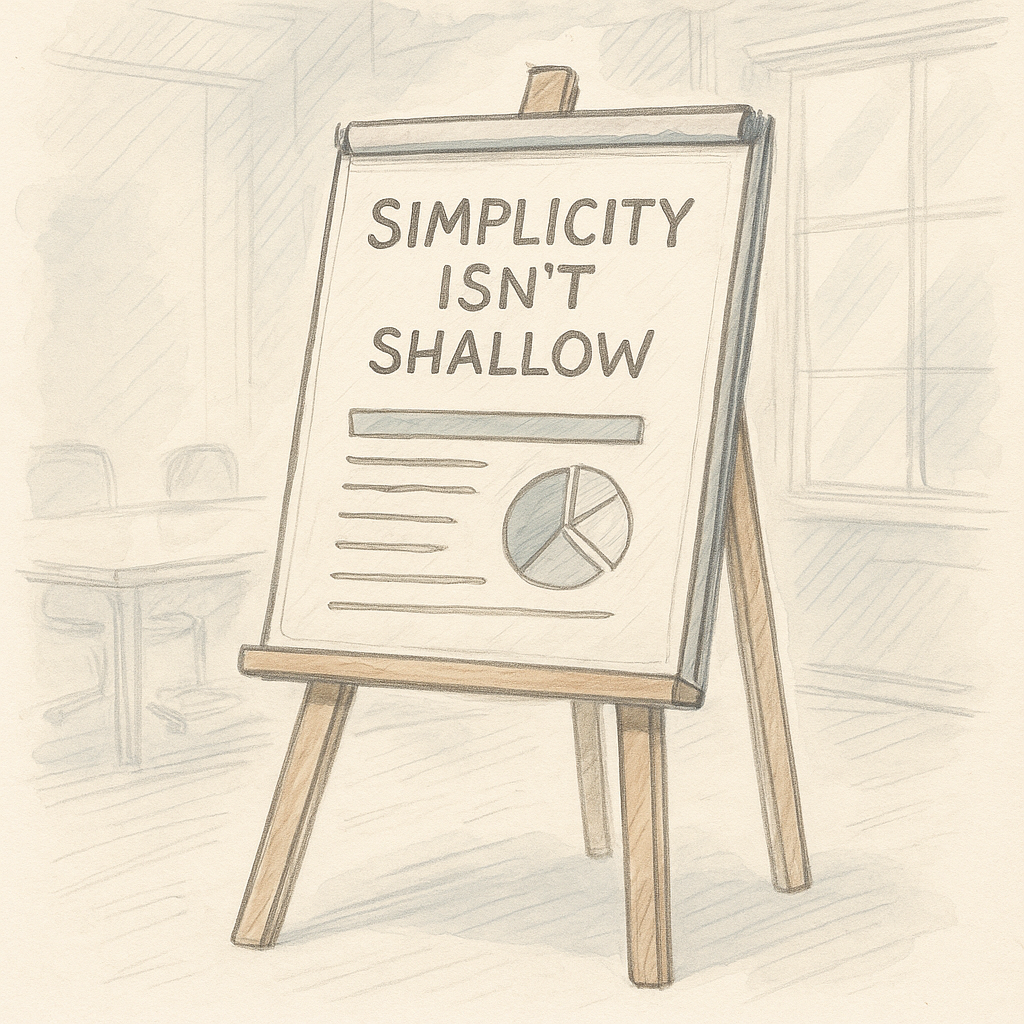
Simplicity isn’t shallow — it’s refined.
Leading by simplicity doesn’t mean reducing effort, oversimplifying real and complex issues, or even ignoring secondary details. Simplicity in leadership is about refining what truly has an impact. It’s choosing clarity over abundance of information, precision over all-encompassing decision. It’s refinement and fine-tuning.
From what I’ve noticed from taught leaders around me, simplicity is speaking so others understand, not just so they’re impressed. Refinement when leading means prioritizing with no regrets for leaving details out, gracefully removing the unnecessary to give room for the essential, and tactfully and assuredly creating work environments where people can focus, contribute, and thrive.
I find it utterly praiseworthy because it’s not about just doing less — it’s about doing meaningfully less.
The elegant discipline of doing less
Simplicity is active, deliberate, and seldom less challenging than complexity. It requires confidence and know-how to say no, to cut through noise, to distinguish and select, to make choices and stand by them. This discipline has a certain grace and elegance. When leaders show they know how to structure time and not waste it uselessly, how to convey and explain expectations, how to make decisions, how to reduce overwhelm, people stay motivated and at ease. This brings clarity to their own work and tasks. They’re not battling against ambiguity or overload because the leaders have made sure to sweep that off their way.
Simplicity in action might look like just one page instead of five, a focused and well-prepared meeting, a plain selection of topics that matter and have potential impact. Knowing what and whom to ask, to delegate, knowing what to expect. It may seem unbelievable, but they work, these small shifts, they’re powerful. And they help teams move with purpose and direction.
A quiet kind of strength
Simplicity is not the absence of leadership effort — it’s the presence of leadership intention. It offers more than efficiency. It offers relief and strength. Quiet, soft, meaningful drive and power.




 Nefelibata
Leave a comment